

Electronic Effects
Electronic effects explain how substituents push or pull electrons through σ- and π-bonds, controlling stability, acidity, reactivity, and physical properties of organic molecules.
The inductive effect is the transmission of electron density through σ-bonds. Electronegative groups withdraw electrons (−I), while alkyl groups donate electrons (+I).
Typical −I groups: I < Br < Cl < F < C=O < C≡N< < CF₃ < NO₂
Typical +I groups: CH₃ < C₂H₅ < i-Pr < t-Bu
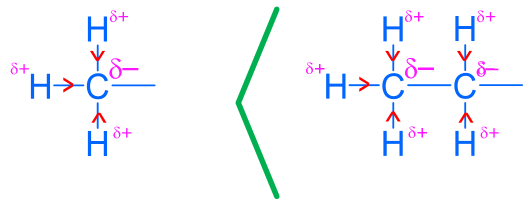
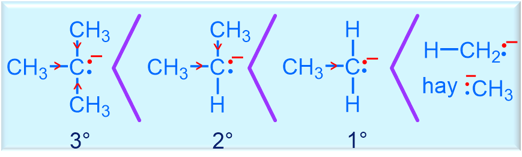
Consequences: −I groups stabilize negative charge but destabilize carbocations; +I groups do the opposite.
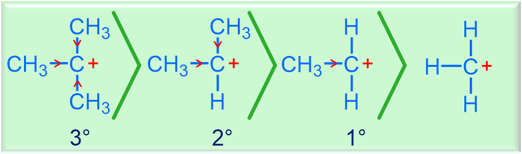
• Carbocations:
• Carbanions:
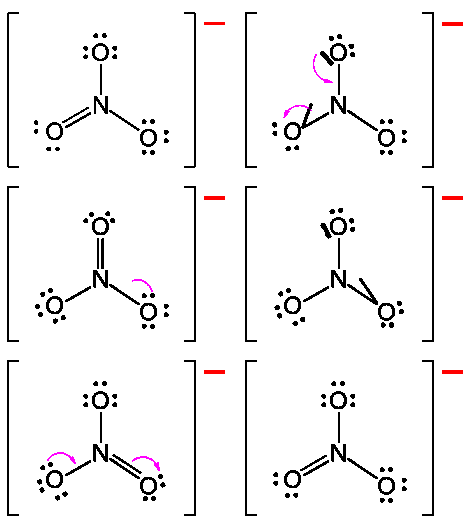
Resonance describes the delocalization of electrons over multiple atoms, represented by multiple contributing structures.
Key idea: Greater delocalization → greater stability.
- Phenoxide (C₆H₅O⁻) is more stable than a simple alkoxide (RO⁻).
- Carboxylate (RCOO⁻) is more stable than an alkoxide because the negative charge is shared by two oxygens.
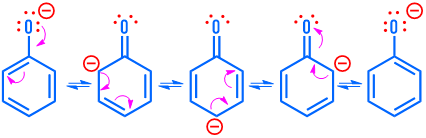
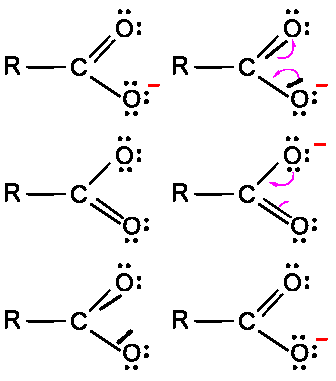
The resonance in the cases of nitrate and carboxylate are called p-π resonance.
For phenoxide (phenolate): between O and C is p-π resonance, the resonance in the benzene ring is between π bonds and is named π-π resonance.
Hyperconjugation is the donation of electron density from C–H σ-bonds to an adjacent empty or partially empty p-orbital.
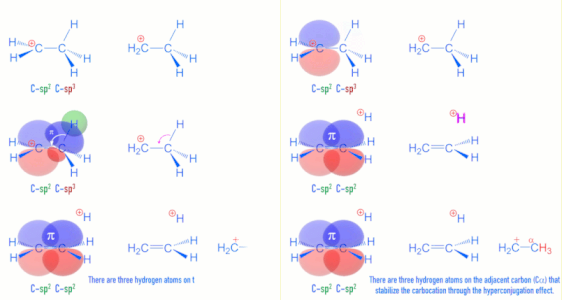
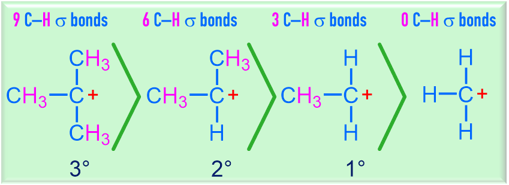
Carbocation stability trend: 3° > 2° > 1° > CH₃⁺
This helps explain why tertiary substrates often favor SN1/E1 pathways (more stable carbocation intermediate).
Electronic effects influence polarity and intermolecular forces, which affect physical properties.
| Property | Trend |
|---|---|
| Dipole moment | Increases with −I substituents (more polar bonds) |
| Boiling point | Increases with polarity and especially with H-bonding |
| Melting point | Often increases with symmetry and efficient packing |
Example: CH₃CH₂OH has a higher boiling point than CH₃CH₃ due to hydrogen bonding.
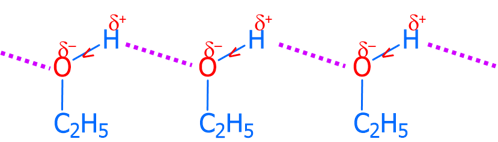
Acids–Bases
Acid–base behavior is the “first filter” for many mechanisms: proton transfers, nucleophile/electrophile strength, leaving-group activation, and whether a reaction is driven by equilibrium.
Brønsted–Lowry: acid donates H⁺, base accepts H⁺.
Conjugate pairs: HA ⇌ H⁺ + A⁻ (A⁻ is the conjugate base).
Quick examples:
-
Water with itself:
H₂O + H₂O ⇌ H₃O⁺ + OH⁻ -
Strong acid in water:
HCl + H₂O → H₃O⁺ + Cl⁻ -
Carboxylic acid:
CH₃CO₂H + H₂O ⇌ H₃O⁺ + CH₃CO₂⁻ -
Ammonia as base:
NH₃ + H₂O ⇌ NH₄⁺ + OH⁻
Illustration (Reaction mechanism):
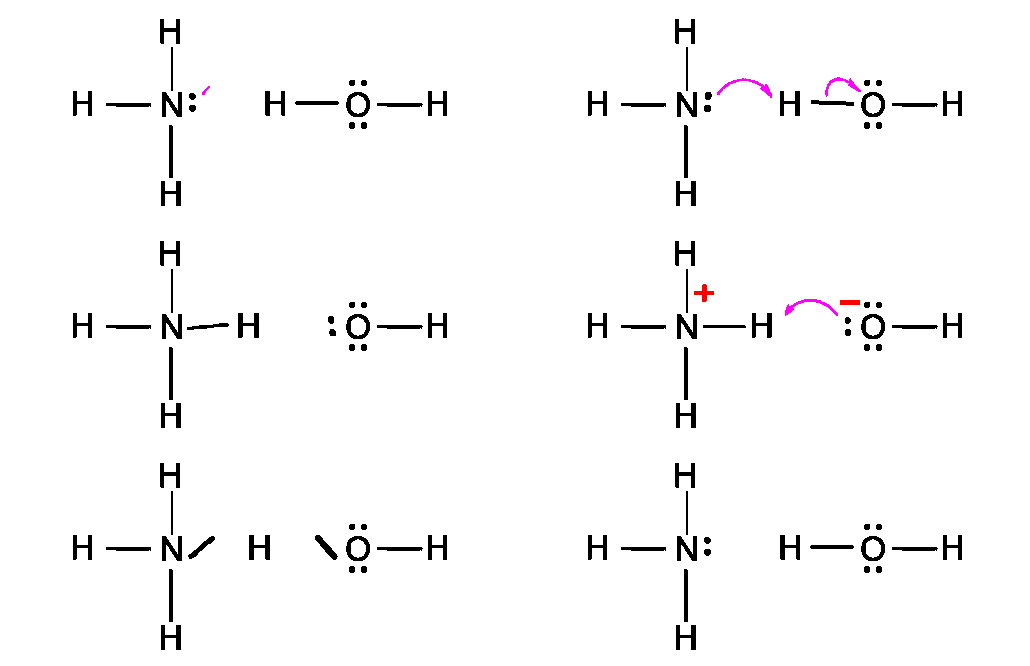
NH₃ (base), NH₄⁺ (conjugated acid)
H₂O (acid), OH⁻ (conjugated base).
pKa measures acidity: lower pKa = stronger acid.
Rule of thumb: reactions favor formation of the weaker acid/base pair.
Henderson–Hasselbalch equation: links solution pH to the ratio of conjugate base to acid and explains buffer behavior.
• With: HA ⇌ H⁺ + A⁻

| Species | pKₐ |
|---|---|
| HCl | –7.0 |
| H₂SO₄ (first dissociation) | –3.0 |
| H₃O⁺ | –1.74 |
| Formic acid (HCO₂H) | 3.75 |
| Acetic acid (CH₃CO₂H) | 4.76 |
| Carbonic acid (H₂CO₃, first) | 6.35 |
| Phenol (C₆H₅OH) | 10.00 |
| Water (H₂O) | 15.74 |
| Ammonium (NH₄⁺) | 9.25 |
| Ammonia (NH₃, conjugate base of NH₄⁺) | 35.0 |
• Lower pKₐ → stronger acid.
• Higher pKₐ → weaker acid (stronger conjugate base).
Acid/base strength tracks stability of the conjugate base/acid.
- More electronegative atom stabilizes negative charge.
- Resonance delocalization stabilizes charge.
- Inductive withdrawal stabilizes anions.
- Larger atoms stabilize charge better (down a group).
Solvents can change “effective” strength.
- Leveling effect: very strong acids/bases appear similar in a given solvent.
- Protic vs aprotic: affects nucleophile/basicity trends.
| Feature | Protic solvents | Aprotic solvents |
|---|---|---|
| H-bonding | Can donate and accept H-bonds | Accept only (no N–H or O–H) |
| Common examples | H₂O, ROH (alcohols), NH₃ | DMSO, DMF, acetone, acetonitrile |
| Effect on nucleophiles | Strong solvation → weaker nucleophiles | Less solvation → stronger nucleophiles |
| Best for SN2 | Generally poor | Generally good |
| Best for SN1 | Generally good (stabilizes ions) | Generally poorer for carbocation formation |
| Leveling effect | Present (strong acids/bases appear similar) | Minimal or absent |
Key takeaway:
• aprotic solvents enhance nucleophilicity.
• protic solvents stabilize ions.
Reaction Mechanisms
Mechanisms explain how bonds break and form. We’ll build this as interactive “pathways”: choose substrate + conditions → see the most likely steps and intermediates.
Core question: one-step backside attack (SN2) or two-step via carbocation (SN1)?
- SN2: strong nucleophile, primary substrate, aprotic solvent.
- SN1: tertiary substrate, weak nucleophile OK, protic solvent; carbocation stability matters.
SN1 vs SN2 — quick comparison
| Feature | SN1 | SN2 |
|---|---|---|
| Substrate (carbocation) | 3° preferred (2° possible) | 1° preferred (2° possible) |
| Nucleophile | Weak nucleophile acceptable | Strong nucleophile required |
| Solvent | Protic (stabilizes ions) | Aprotic (enhances nucleophilicity) |
| Leaving group | Good leaving group needed | Good leaving group needed |
| Rate law | Rate = k[substrate] | Rate = k[substrate][nucleophile] |
| Stereochemistry | Racemization (planar carbocation) | Inversion (backside attack) |
| Mechanism steps | Two steps (ionization → attack) | One step (concerted) |
Decision tree
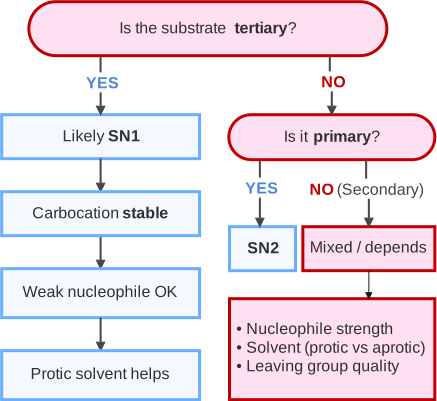
Predict SN1 vs SN2
Elimination competes with substitution.
- E2: strong base, concerted; needs anti-periplanar geometry.
- E1: via carbocation; often with SN1 conditions.
E1 vs E2 — Quick comparison
| Feature | E1 | E2 |
|---|---|---|
| Mechanism type | Stepwise (2 steps) | Concerted (1 step) |
| Carbocation | 3° best (2° possible) | No carbocation formed |
| Base | Weak base preferred | Strong base required |
| Solvent | Protic favored | Aprotic favored |
| Substrate | 3° > 2° > 1° | 3° > 2° > 1° |
| Major product | More substituted alkene (Zaitsev) | Usually more substituted (Zaitsev), but bulky base → Hofmann |
| Stereochemistry | Mixture possible | Anti-periplanar requirement |
Decision tree
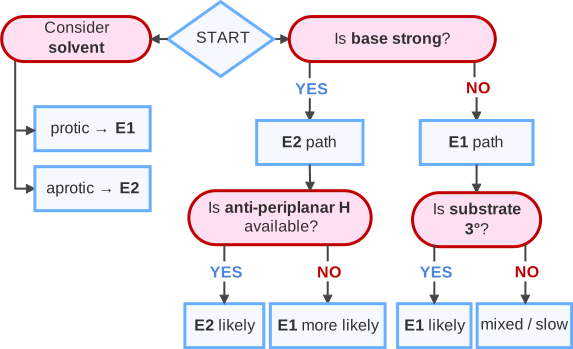
Predict E1 vs E2
Zaitsev vs Hofmann + Anti-periplanar check
1) Predict major alkene
2) Anti-periplanar requirement (E2)
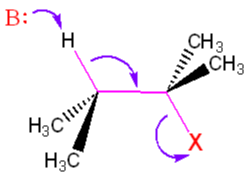
✔ Anti-periplanar — E2 allowed
Additions to C=C involve attack on an electrophilic π bond of an alkene.
- Hydrohalogenation: HBr, HCl (Markovnikov vs anti-Markovnikov)
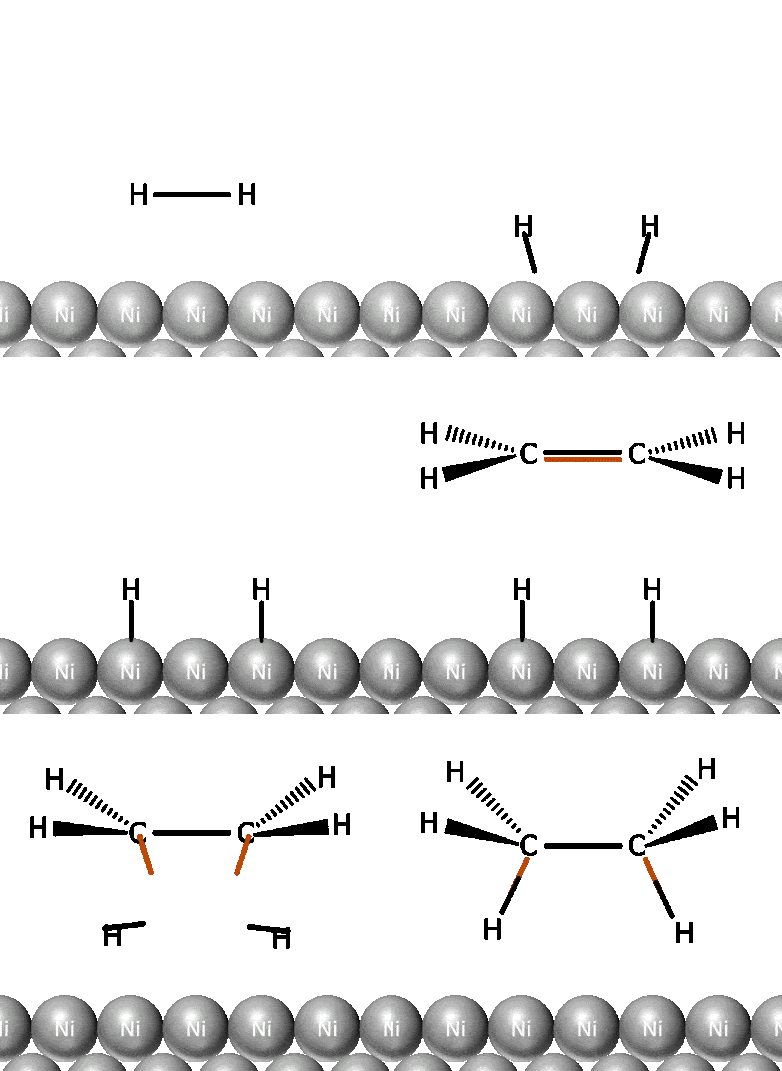
- Hydrogenation: H₂, cat. Ni (syn addition)
- Halogenation: Br₂, Cl₂ (anti addition)
- Hydration: H₂SO₄ / H₂O → alcohol
- Radical pathway: HBr + peroxides
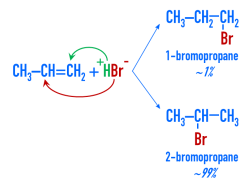
2-bromopropane (Markovnikov rule)
 >
>
Hydrogenation: syn addition with Ni catalyst

Additions to C=C — quick comparison
| Reaction | Reagent | Product / Key feature |
|---|---|---|
| Hydrohalogenation (ionic) | HBr, HCl | Markovnikov alkyl halide (carbocation pathway; rearrangements possible) |
| Hydrohalogenation (radical) | HBr + peroxides | Anti-Markovnikov alkyl halide (radical chain; no rearrangement) |
| Hydrogenation | H₂, Ni (or Pd, Pt) | Alkane via syn addition of H₂ |
| Halogenation | Br₂ or Cl₂ | Vicinal dihalide via anti addition (halonium ion) |
| Acid-catalyzed hydration | H₂SO₄ / H₂O | Markovnikov alcohol (carbocation pathway) |
| Hydroboration–oxidation | BH₃/THF → H₂O₂, OH⁻ | Anti-Markovnikov alcohol, syn, no rearrangement |
| Dihydroxylation | KMnO₄ (or OsO₄) | Vicinal diol (glycol), concerted syn addition |
Decision tree
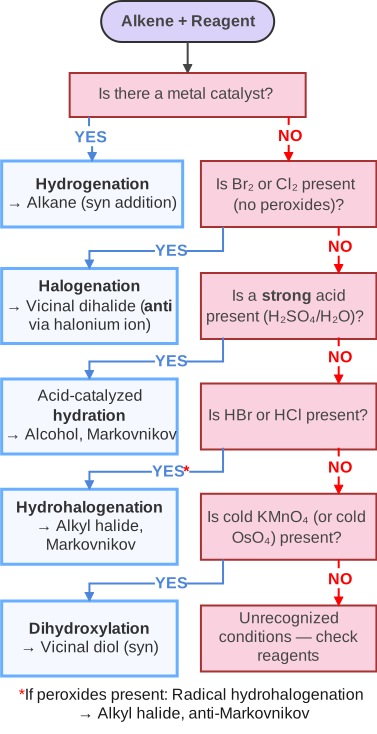
(Later: add curved-arrow mechanism diagrams.)
Carbonyl C=O is polarized: C is electrophilic, O is nucleophilic.
- Nucleophilic addition to aldehydes/ketones
- Acyl substitution for carboxylic derivatives
Carbonyl carbon is electrophilic due to C=O polarization; nucleophiles attack the carbonyl carbon.
| Reaction | Reagent | Product / Key feature |
|---|---|---|
| Hydride reduction (mild) | NaBH₄ | Aldehyde → 1° alcohol; Ketone → 2° alcohol |
| Hydride reduction (strong) | LiAlH₄ | Reduces aldehydes, ketones, esters, acids → alcohols |
| Cyanohydrin formation | HCN | H⁺ and C≡N⁻ added; forms cyanohydrin RCH(OH)CN |
| Acetal / ketal formation | ROH + acid | Protecting group; forms acetal / ketal (reversible) |
| Imine formation | RNH₂ + acid | C=N (imine); condensation reaction |
| Grignard addition | RMgBr (then H₃O⁺) | New C–C bond; alcohol formed after workup |
| Acyl substitution | Acid chloride / ester + Nu⁻ | Addition–elimination (nucleophilic acyl substitution) |
Predict carbonyl reaction
(Later: add curved-arrow stepper with tetrahedral intermediate.)
SR (radical substitution) proceeds via a radical chain mechanism: initiation → propagation → termination.
- Typical: Alkane halogenation (Cl₂ / Br₂, hν or Δ)
- Key factors: radical stability & selectivity (Br₂ more selective than Cl₂)
- Outcome: mixture of products; controlled by relative H-abstraction rates
| Feature | Description |
|---|---|
| Typical substrate | Alkanes (sp³ C–H bonds) |
| Reagents | Cl₂ or Br₂ + light (hν) or heat (Δ) |
| Mechanism type | Free radical chain reaction |
| Steps |
1) Initiation (radical formation) 2) Propagation (chain continues) 3) Termination (radicals combine) |
| Selectivity |
Br₂ is more selective than Cl₂ (3° > 2° > 1°) |
| Major product rule | Hydrogen is replaced at the position that forms the most stable radical |
| Initiation | Cl₂ → 2 Cl• (homolytic cleavage) |
| Propagation (step 1) |
Cl• + R–H → HCl + R• |
| Propagation (step 2) |
R• + Cl₂ → R–Cl + Cl• |
| Termination |
Cl• + Cl• → Cl₂ R• + Cl• → R–Cl R• + R• → R–R |
Radical halogenation is thermodynamically driven by bond strengths and kinetically influenced by radical stability.
Predict Radical Substitution Product Distribution
| Type | Count |
|---|---|
| 1° (primary) | |
| 2° (secondary) | |
| 3° (tertiary) |
(Later: add an interactive “which H is substituted?” selector + selectivity chart.)
Electrophilic Aromatic Substitution (EAS) preserves aromaticity. An electrophile replaces a hydrogen on the benzene ring.
| Step 1 | Formation of strong electrophile (E⁺) |
| Step 2 | Aromatic ring attacks E⁺ → σ-complex (arenium ion) |
| Step 3 | Deprotonation restores aromaticity |
The σ-complex (arenium ion) is resonance-stabilized but temporarily loses aromaticity.
| Reaction | Reagents | Electrophile |
|---|---|---|
| Halogenation | Br₂ / FeBr₃ or Cl₂ / FeCl₃ | Br⁺ or Cl⁺ |
| Nitration | HNO₃ / H₂SO₄ | NO₂⁺ (nitronium) |
| Sulfonation | SO₃ / H₂SO₄ | SO₃ or HSO₃⁺ |
| Friedel–Crafts alkylation | R–Cl / AlCl₃ | R⁺ (carbocation) |
| Friedel–Crafts acylation | RCOCl / AlCl₃ | RCO⁺ (acylium) |
| Substituent Type | Examples | Direction | Activation |
|---|---|---|---|
| Electron-donating (EDG) | –OH, –OR, –NH₂, –R | Ortho / Para | Activating |
| Weakly deactivating halogens | –Cl, –Br | Ortho / Para | Deactivating |
| Electron-withdrawing (EWG) | –NO₂, –CF₃, –CN, –COOH | Meta | Deactivating |
Rule of thumb:
• EDG → stabilize σ-complex → ortho/para
• Strong EWG → destabilize ortho/para σ-complex → meta