

Isotopes & Nuclear Chemistry
Learn how isotopes determine atomic mass and nuclear stability. Use interactive tools to solve atomic mass problems, interpret nuclear symbols, and calculate binding energy and nuclear energetics..
Topic
| Setup | |
|---|---|
| Number of isotopes | |
| Solve for | |
| Unknown abundance | Used only for “Missing abundance”. |
| Unknown isotope mass | Used only for “Unknown isotope mass”. |
| Isotope data | ||
|---|---|---|
| Average atomic mass A (u) | ||
| Isotope 1 mass A1 (u) | ||
| Isotope 2 mass A2 (u) | ||
| Isotope 3 mass A3 (u) | ||
| Enter abundances as percent. Rule: 2 isotopes → 1 known ⇒ other = 100 − known. 3 isotopes → 2 known ⇒ third = 100 − sum. | ||
Percent input guide:
• Enter abundances as 75, 75%, 0.75, or 81.24 (comma also accepted).
• You may leave one or more abundances blank.
• Click Calculate to auto-generate the remaining value(s).
• Auto-generated fields will turn grey and become locked.
• Enter abundances as 75, 75%, 0.75, or 81.24 (comma also accepted).
• You may leave one or more abundances blank.
• Click Calculate to auto-generate the remaining value(s).
• Auto-generated fields will turn grey and become locked.
Interpretation
| Nuclear symbol / particles | |
|---|---|
| Element symbol (optional) | |
| Atomic number Z | |
| Mass number A | |
| Charge (optional) | |
Interpretation
Radioactive Decay & Dating
The Radioactive Decay & Dating module provides an interactive framework for mastering nuclear decay processes and radiometric age determination.
Topic
| Setup | |
|---|---|
| Element | |
| Isotope (mass number A) | |
| Decay type | |
| Apply multiple times |
|
How it works:
• α: Z − 2, A − 4
• β⁻: Z + 1, A unchanged
• β⁺ / EC: Z − 1, A unchanged
• γ: no change in Z or A
• α: Z − 2, A − 4
• β⁻: Z + 1, A unchanged
• β⁺ / EC: Z − 1, A unchanged
• γ: no change in Z or A
| Setup | |
|---|---|
| Element | |
| Isotope (A) | |
| Solve for | |
| Half-life t₁/₂ |
|
| Inputs | |
|---|---|
| Initial amount N₀ |
|
| Remaining amount N | |
| Time elapsed t |
|
| Fraction / percent remaining |
|
Interpretation
| Setup | |
|---|---|
| Element | |
| Isotope (A) | |
| Solve for | |
| Half-life t₁/₂ |
|
| Decay constant λ |
Unit is 1/(chosen time unit)
|
| Inputs | |
|---|---|
| Initial amount N₀ | |
| Remaining amount N | |
| Time t |
|
| Ratio N/N₀ | |
Key formulas:
• λ = ln(2)/t₁/₂
• N = N₀·e−λt
• A = λN
• λ = ln(2)/t₁/₂
• N = N₀·e−λt
• A = λN
Interpretation
| Setup | |
|---|---|
| Dating mode | |
| Parent element | |
| Parent isotope (A) | |
| Half-life t₁/₂ |
|
| Inputs | |
|---|---|
| Fraction remaining f |
|
| Parent amount P | |
| Daughter amount D | |
| Initial daughter D₀ | |
| Time unit for answer | |
Interpretation
Isotope Applications
Isotope Applications explores how isotopes are used to analyze molecular structure, reaction mechanisms, and chemical transformations through mass spectrometry & isotope patterns, kinetic isotope effects (KIE), and isotope exchange reactions..
Topic
Kinetic Isotope Effect (KIE)
RDS / Mechanism
Definition: KIE = k(light) / k(heavy) (often kH/kD). Large KIE suggests the X–H bond is involved in the rate-determining step (RDS).
Typical ranges
Primary: ~2–8 (bond to H broken in RDS)
Secondary: ~1.1–1.3 (hybridization change)
None: ~1.0 (H not involved in RDS)
Mechanism clues
E2: usually large (β-H broken in RDS)
E1/SN1: usually small (carbocation formation RDS)
SN2: usually small (no C–H breaking)
Why does KIE exist? (ZPE idea)
Heavier isotopes vibrate more slowly → lower zero-point energy → effectively larger activation energy for breaking that bond → slower rate → k(light) > k(heavy).
KIE Calculator
Arrhenius inputs
Uses k = A e^(−Ea/RT) with same A assumption:
KIE = exp((Ea(heavy) − Ea(light)) / (R·T)).
Experimental inputs
KIE = k(light) / k(heavy)
Practice Generator (Mechanism Detective)
Isotope Exchange Reactions
Rule Navigator
| D/H Exchange (Proton Exchange) |
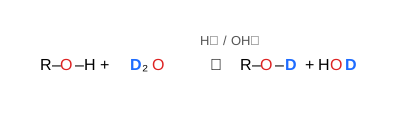
Hydrogen atoms attached to heteroatoms (O–H, N–H, S–H) can exchange with deuterium
through rapid reversible proton transfer. This occurs whenever the molecule can undergo acid–base equilibrium with D₂O. Example reaction: ROH + D₂O ⇌ ROD + HOD |
|
|
| α-Hydrogen Exchange (Enol/Enolate Mechanism) |
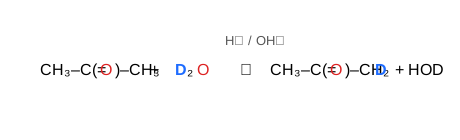
Hydrogen atoms on the α-carbon next to a carbonyl group can exchange with deuterium
because the carbonyl compound can form an enol or enolate intermediate. Repeated enolization gradually replaces all α-hydrogens. Example reaction: CH₃COCH₃ + D₂O ⇌ CH₃COCH₂D + HOD |
|
|
| ¹⁸O Exchange (Carbonyl Oxygen Exchange) |
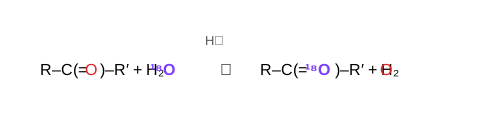
Carbonyl oxygen atoms can exchange with labeled water (H₂¹⁸O) through reversible
hydration of the carbonyl group. The gem-diol intermediate allows the original oxygen to be replaced by ¹⁸O. Example reaction: R–C(=O)–R′ + H₂¹⁸O ⇌ R–C(=¹⁸O)–R′ + H₂O |
|
|
| Requirement: Reversibility |
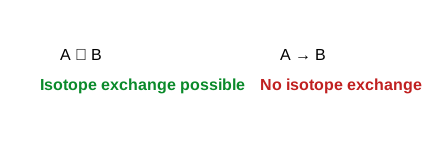
Isotope exchange only occurs when the reaction mechanism includes reversible bond
breaking and re-formation. If a reaction step is irreversible, isotope scrambling will not occur. Example comparison: A ⇌ B (exchange possible) A → B (no isotope exchange) |
|